Free demo
If you work in security, you’ll be familiar with concepts like Network Video Recorders (NVR) and Digital Video Recorders (DVR). Particularly, if you specialise in video surveillance solutions. When installing a video surveillance system, you need to decide whether to opt for a networked digital recorder. The question is, which is better: NVR or DVR?
NVR are an important component of any networked video surveillance system. One of their main functions is to store video signals sent by IP cameras connected to the equipment to give remote access to data.
A DVR recorder processes analogue images and saves them in digital format on a hard drive or equivalent. That is the main difference: a DVR converts analogue images to digital format, while an NVR, generally speaking, only functions with digital images.
Both DVR and NVR record video sequences and store them on an external hard drive. However, there are differences regarding how the data is processed and how the equipment is configured.
NVR vs DVR: the difference that defines your security architecture
The choice between an NVR (Network Video Recorder) and a DVR (Digital Video Recorder) is not just technical: it determines the capacity for integration with video analytics systems and the scalability of the entire installation.
The DVR works with analog cameras. It receives the video signal via coaxial cable and digitizes it internally. It is mature, cost-effective technology for small installations, but with significant limitations when adding intelligence: lower maximum resolution, more complex integration with external software, and more restricted remote management.
The NVR works with IP cameras. It receives already-digitized video via network, enabling higher resolution, centralized management, and above all, direct integration with video analytics engines like DFUSION /3.
Which allows better integration with video analytics?
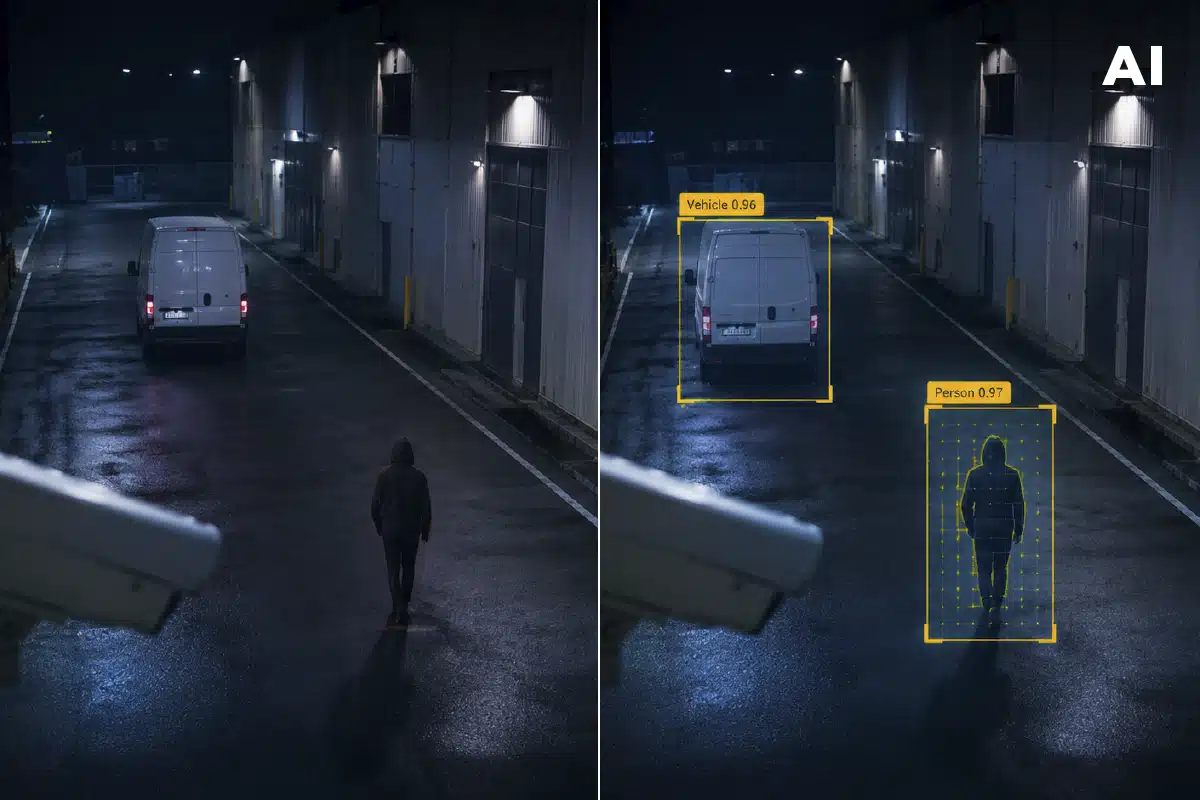
NVR systems are clearly the recommended option when the goal is to add intelligent video analytics. DFUSION /3 integrates directly with IP cameras via ONVIF without going through the recorder. The NVR acts as storage while the analytics engine works in parallel on the same video stream.
With a DVR, integration is possible but more limited: it requires signal converters or compatible HD-over-coax cameras, adding cost and complexity without reaching the same performance level.
Recommendations by installation type
Starting from scratch or renewing an installation? An NVR with IP cameras is the recommended base for any system incorporating video analytics. Already have a DVR and want to know your integration options? Our technical team can analyze your infrastructure and offer the most efficient path forward.
Location
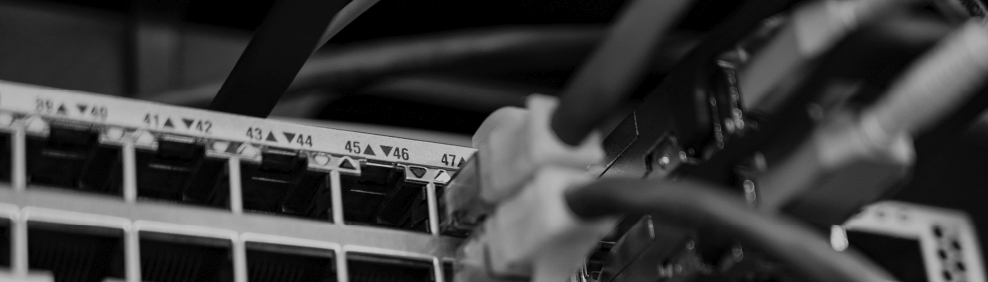
DVR recorders need to be on the same site as all the analogue signal wiring, i.e. this equipment is connected to an analogue CCTV system via a coaxial cable to the analogue signal input of the DVR. In the case of the NVR, this is not necessary. The equipment can be located outside the facility where the security cameras are located. This is because the connection with the cameras is via IP (LAN or WAN), which guarantees correct data traffic.
Video processing
The video in a DVR is encoded and processed in the DVR, while video on an NVR is encoded and processed in the camera and then transmitted to the NVR for storage or remote viewing.
Number of cameras
A DVR can only connect to a limited number of cameras, while an NVR can connect to an unlimited number of cameras. PoE and wireless IP cameras are used in NVR systems. At the same time, a DVR recorder connects to HD security cameras and other CCTV, and the quality of images and sound are of lower quality.
Processing capacity
NVRs have increased storage and processing capacity, a vital feature for video analytics solutions. This allows businesses to have a device that provides greater storage capacity, remote access, data security, and scalability.
If you still have doubts about the type of recorder you need in your installation, you should ask yourself: What kind of hardware is wired? Are you experienced in designing and configuring network devices? What kind of maintenance does the system require? What kind of access will the installation allow? Remote access? among others. Depending on your answers, you can opt for one system or another or even a hybrid NVR/DVR surveillance system that integrates both NVR and DVR functions.
As video surveillance systems evolve technologically, they bring new opportunities for accuracy and efficiency. However, our video analytics systems are compatible with both NVR and DVR recorders, achieving full integration and maximising security and protection levels.
Learn how DFUSION can improve your perimeter security system!