Free demo
Every year, alarm receiving centres handle millions of alarm signals that should never have been triggered. Here’s what causes them—and what really reduces them.
A siren sounds for no apparent reason. An Alarm Receiving Centre (ARC) operator dispatches someone to verify an incident that turns out to be nothing more than a cat crossing the yard. A security guard drives several miles only to discover that the alarm was triggered by a branch moving in the wind.
If you work in security, this scene will feel familiar. It is the daily reality of any video surveillance system that relies on conventional motion detection.
False alarms are not an occasional system failure. In most installations, they are the norm. Understanding why they occur—before trying to solve them—is the first step towards eliminating the hidden costs they create.
76%of the signals received by Alarm Receiving Centres do not correspond to a genuine threat. Only one in four alarms requires real attention.
What exactly is a false alarm?
A false alarm—or false positive—occurs when a security system detects movement or activity and generates an alarm, but once the event has been verified, no genuine threat is found. The system “sees” something, interprets it as suspicious, and raises an alert. The problem is that outdoors, almost everything moves.
This is different from a false negative, where the opposite happens: a genuine intrusion occurs, but the system fails to detect it. Both are system errors, but their consequences are very different. False alarms waste time and money. False negatives can cost far more.
False alarms: the most common causes
Most false alarms in outdoor perimeter security can be traced back to a handful of recurring causes. Understanding them makes it easier to identify why a particular system is generating unnecessary alerts.
- Rain, fog and snow
- Wind moving vegetation
- Sudden lighting changes
- Reflections and moving shadows
- Insects close to the camera lens
- Birds flying through the scene
- Cats, dogs and rodents
- Wildlife in rural environments
- Cameras aimed at authorised access routes
- Vibrating mounting brackets
- Poorly defined exclusion zones
- Vegetation growing into the camera’s field of view
- Basic motion detection
- No object classification
- Poorly calibrated sensitivity thresholds
- Limited event analysis

The cost that few organisations calculate
Every false alarm triggers a process: an operator reviews the event, decides whether it should be escalated, and in many cases dispatches a security guard or patrol to verify the incident on site. Across hundreds or thousands of installations, this process consumes an enormous amount of time and resources that few organisations fully quantify.
However, the financial cost is only part of the problem. There is a more subtle—and more dangerous—effect: alarm fatigue. An operator who has dealt with hundreds of false alarms during a shift naturally becomes less responsive to the next alert. Unfortunately, that next alert could be genuine.
The problem is not simply the noise. It is what the noise hides. A system with a high false alarm rate not only increases operating costs; it also raises the risk that a genuine intrusion will be overlooked amongst the constant flow of irrelevant alerts.
How can false alarms be reduced?
There is no single solution, but there is a logical order of action.
- Review the installation. Many false alarms can be eliminated simply by repositioning a camera, trimming vegetation from the field of view, or correcting the installation height. This is the lowest-cost solution and should always be the first step.
- Optimise the configuration. Define exclusion zones for authorised access areas, adjust sensitivity according to the time of day, and tailor detection rules to the actual use of each site.
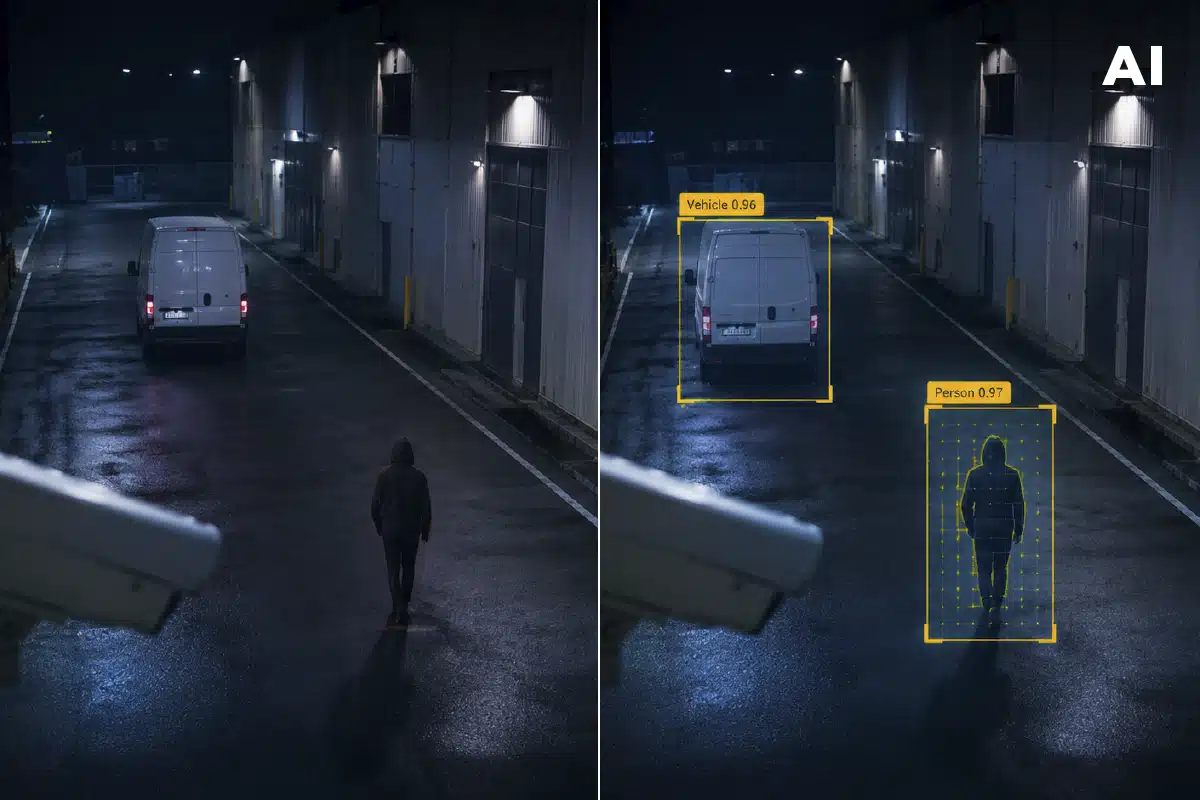
- Incorporate Artificial Intelligence into detection. This is where the real step change occurs. A system that only detects motion cannot distinguish between a person and a leaf blowing in the wind. A system that also analyses what is moving—its shape, size and behaviour—can.
This is where today’s technology has transformed the industry. The difference between a traditional CCTV system and an advanced AI-powered video analytics solution is not an incremental improvement—it is a completely different approach to separating genuine threats from irrelevant activity.
Traditional CCTV vs DFUSION /3: how detection changes
This is the fundamental difference between a conventional CCTV system and an AI-powered dual-engine video analytics solution such as DFUSION /3, focusing on the areas where false alarms are truly decided.
| TRADITIONAL CCTV | DFUSION /3 | |
|---|---|---|
| What it detects | ✕ Pixel changes in the image (generic motion) | ✓ People and vehicles, classified by appearance and behaviour |
| How it identifies a threat | ✕ It doesn’t—any movement can trigger an alarm | ✓ Dual-engine technology combining object appearance and movement patterns |
| Sensitivity to wildlife and insects | ✕ High—a cat, bird or spider on the lens can trigger an alarm | ✓ Automatically filters wildlife by recognising that it is not a person or vehicle |
| Rain, wind and lighting changes | ✕ Highly sensitive—weather frequently triggers alarms | ✓ Trained for real-world outdoor weather conditions |
| Where image processing takes place | Depends on the system—often recording only, with little or no analysis | ✓ Edge processing using dedicated hardware installed on site |
| Operates without an internet connection | ✓ Yes, in most cases recording continues locally | ✓ Yes—the analysis is performed directly on the device |
| False alarm rate | ✕ Up to 76% of generated alarms are not genuine threats | ✓ Up to 99% reduction compared with conventional systems* |
| Risk of missed detections (false negatives) | ✕ Higher—alarm fatigue reduces operator attention | ✓ Lower—the system escalates only verified events |
| Workload for the ARC | ✕ High—operators manually filter every alarm | ✓ Low—the ARC receives pre-qualified events |
| Scalability for the ARC | ✕ Limited—more sites require more operators | ✓ High—the same team can manage more sites with significantly less noise |
| Loitering detection before an intrusion | ✕ No—only isolated movement is recorded, with no context | ✓ Yes—identifies prolonged or repeated presence patterns |
*False alarm reduction demonstrated in real-world installations using DFUSION technology. Actual performance may vary depending on the specific conditions of each installation.